Identifying Wild Mushrooms
Identifying wild mushrooms is an amazing and practical skill set. Learn how to identify edible mushrooms, the benefits of befriending wild mushrooms, get resources for edible mushroom identification, and more! These amazing delicacies will rock your world!
What is a mushroom?
It could be easy to think of a mushroom as a vegetable since they're often cooked into classic dishes like stir-fry with other vegetables. In the process of identifying wild mushrooms it's important to know that a mushroom is actually a fungus, not a vegetable. What most people think of as a mushroom is actually just the "fruit" of a much larger organism that includes the thread like underground "roots" called mycelium. Let's take a closer look at the benefits that are waiting for us before learning about identifying wild mushrooms.
Benefits of identifying wild mushrooms
There are many gifts to making friends with wild mushrooms. Let's start with the immediate joy and pleasure of eating them. There are a variety of mushrooms all with different flavors and earthy aromas and every succulent bite tastes delish! This is just the start of an incredible life-long opportunity to connect with them.
The aspiration and enthusiasm of searching for mushrooms can be as deeply fulfilling as it was for King Arthur to quest after the Holy Grail. The satisfaction of discovery, the skillful finesse of using our senses to identify wild mushrooms, and the emotional connection we cultivate with nature is worth so much more than buying them at the store.
The health benefits of wild mushrooms are tremendous. They improve the health of your skin; they boost your energy levels, lower cholesterol and are packed with numerous vitamins and minerals. Some mushrooms are drunk as a tonic, some treat wounds, and many contain important enzymes and anti-oxidants that lend a helping hand to the overall health of your immune system. And if that weren't enough, there are some mushrooms that are used as a remedy to help with arthritis and inhibit diabetes and cancer. And the cherry on top is that wild mushrooms are free!
Identifying wild mushrooms - a primer
It's spring and you're excited for a mushroom foray! There you are walking in the woods after a spell of rain. Whoops! You've slipped on a nice damp matted pile of leaves and landed on the forest floor. You're perfectly poised for an encounter with a wild mushroom. There you are, nose-to-nose with the most beautiful gastronomic delights you've ever seen. Or so you think. In order to know if these mushrooms will be fit for a gourmet feast we need to look closely at these mushrooms and begin to identify their parts.
The mushrooms most people are familiar with are actually just the "fruit" of a much larger organism. The whole organism of a mushroom consists of the mycelium "roots" plus the "fruit".
There are four main body parts to most mushrooms:
- Cap: the "hat" or umbrella-shaped top of the mushroom sitting on the stalk.
- Gills, tubes, spines, and ridges: what lives on the underside of the cap and releases spores.
- Stalk: what the mushroom cap stands on.
- Mycelium: the roots that push the mushroom up for spore dispersal and your foraging!
It really helps to have a basic primer on mushroom parts. It makes identifying wild mushrooms that much simpler when we are out in the field. In their own right, mushrooms contain a world of mysteries. There's a lot of action going on under the soil that we don't even see. By identifying them, we demystify them. This isn't to say we've taken away the air of mystery. That will always be present in these ethereal beings. By being able to easily distinguish their parts we break down the intimidation and hesitancy that can go along with the territory of identifying wild mushrooms.
The Foolproof Four
Identifying wild mushrooms requires awareness and understanding of their parts. There are many poisonous look-a-likes. Just like studying all the other aspects of nature, begin learning a handful of the most definitive mushrooms first. The "foolproof four" are some of the best species to start with for edible mushroom identification. These mushrooms are relatively easy to identify. They are the giant puffballs, morel mushrooms, chicken of the woods, and the chanterelles.
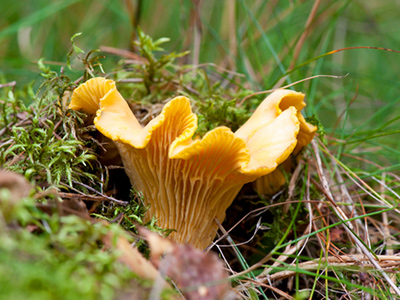
Chanterelle (Cantharellus cibarius)
The chanterelle mushroom looks like a beautiful curled vessel, and is known as a wild delicacy. With white to yellow flesh, these mushrooms have a fruity smell and gentle flavor you'll enjoy.
Cap: Bearing an orange to yellowish cap with wavy or downward curled edges with some edges turned up. The middle of the mushroom can often dip inwards. Younger chanterelle caps are less curled with a flat top.
Gills: Its underside is smooth, wrinkled or lined with thick light orange to yellow gills with narrow depth. Veins are interconnected.
Stalk: Grows from a solid and robust light orange to pale yellow stalk, tapering at the bottom.
Spores: yellow
Size: These mushrooms are medium to large in size when they reach maturity.
Season: Fall to early spring
Habitat: Can be found growing right on the ground, sometimes as a group in open woods and forests and often under trees.
Range: It can be found throughout the western states and Alaska.
Morel (Morchella esculenta)
Morel mushrooms are some of the most prized edible mushrooms. They are known for their classic honeycomb cap and rich, gourmet flavor!
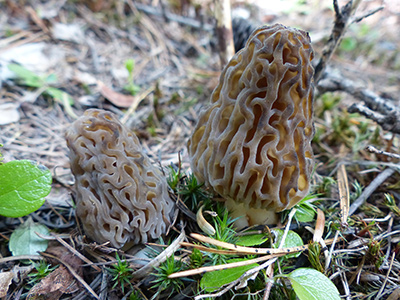
Cap: brown cap is round to oval or conical. The cap has a wavy honeycomb look to it with darker brown holes throughout the entire cap.
Gills: gills not apparent
Stalk: The cap and tan colored stalk are joined and the mushroom is hollow.
Spores: It does not have a sac at the stalk's base.
Size: 1 to 12 inches tall
Season: can be found in the springtime
Habitat: Can be found growing on the ground among leaf litter in woods, forests, in sandy soils and near rivers and streams. Especially likes wet and damp places.
Range: Found throughout North America
If you're interested in morel mushrooms, be sure to check out our other articles: Morel Mushroom Hunting and Morel Recipes!
Western Giant Puffball (Calvatia booniana)
This giant puffball is true to its name, looking like a puffed ball or a balloon. It is round or oblong in shape. They are at their best when the flesh is firm and white on the inside. Yellow or green flesh may cause an upset stomach. The flesh is white when young and brown to greenish brown at maturity.
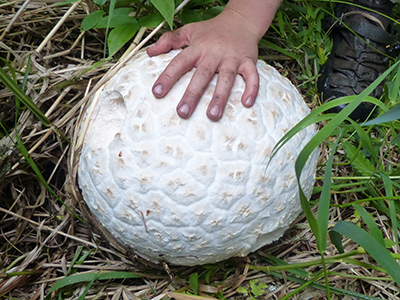
Cap: This thick-skinned mushroom is white with white to light brown textured marks all over.
Gills: gills absent
Stalk: It grows without a stalk.
Spores: Spores can be found inside round sacks
Size: Can grow up to 10 inches or more in diameter.
Season: Found summer to fall
Habitat: Can be found growing on the ground in grassy fields, hillsides, and open areas, lawns, on rotting wood and near roads.
Range: Found throughout North America
Sulfur Shelf "Chicken of the Woods" (Laetiporus sulphureus)
A group of stacked semi-wrinkled shelves on various tree species, many say this mushroom tastes like chicken (thus, its' name). Their flesh is yellow to orange white. These mushrooms can be watery upon collecting from trees.
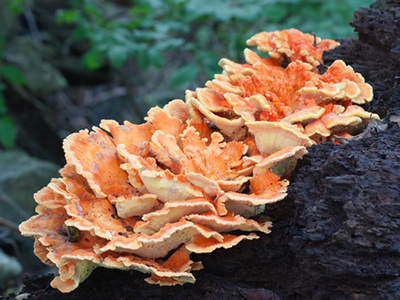
Cap: Yellow to orange shelf often with an edge of lining that is brighter orange yellow. Ripe mushrooms are damp and rubbery. Older mushrooms are lighter in color, woody and hardened.
Gills: bright yellow tiny pores on the underside
Stalk: very short stubby stalk connected to bark making it seem like there is no stalk
Spores: white
Size: Shelves are 2 to 20 inches in length on trees
Season: Found from mid to late summer to fall
Habitat: Can be found growing on the wood of deciduous and conifer trees such as oak, beech, yew, willow, cherry and chestnut. Found growing at the base or moving up high on the tree bark.
Range: found throughout North America
Beyond the foolproof four, there are a ton of other mushrooms out there and it is vast and beyond the scope of this article. I recommend you get an extensive mushroom field guide (see below for ideas)that will help you delve more deeply into the world of mushrooms.
Making Spore Prints
Another aspect of identifying wild mushrooms is to make spore prints of the mushrooms you find. Simply remove the stalk from the mushroom and place the cap and gills downward on a piece of white paper or glass. Place a large glass cup or jar upside down over the mushroom (to keep air from getting in).
Wait until the next day to remove the glass jar or cup. When you lift the mushroom cap from the paper or glass you'll find a print of the spores that fell. The various colors of mushroom spores are often listed in field guides. Adding to your primary mushroom identification process, this is another all-around fun way to learn how to identify edible mushrooms!
Top 10 edible mushroom groups in North America
There are thousands and thousands of mushroom species. Besides the foolproof four, learning the most common mushroom groups will accelerate your journey of identifying wild mushrooms. So here's a list of the top 10 most common edible mushroom groups in North America. Go forth mushrooming!
- Boletes
- Morels
- Chanterelles
- Teeth Fungi
- Coral Fungi
- Club Fungi
- Milk Caps
- Russulas
- Light-spored gilled mushrooms with a ring
- Light-spored gilled mushrooms without a ring
Beyond edible mushrooms identification
So you've been learning how to identify edible mushrooms. Besides the fact that eating them is at the top of the list there are a myriad of other interesting uses. Some of them make good fire starters and others are substitutes for coffee. Many are prized for making wine and are wonderful for dyeing with wool and other fibers. Mushrooms are used for creating art, helping other plants to grow, and restoring health to toxic environments. These versatile fungi are even used in our modern world today to make biodegradable packaging!
Resources for identifying wild mushrooms
There are some great resources for identifying wild mushrooms. For more information on edible wild mushrooms go to our article Encountering Edible Wild Mushrooms. Here's a great list of books that will help you learn about identifying wild mushrooms as well!
- Peterson's Field Guide to Venomous Animals and Poisonous Plants by Steven Foster, Roger Caras and Roger Tory Peterson
- Start Mushrooming by Stan Tekiela and Karen Shanberg
- Treasures from the Kingdom of Fungi by Taylor Lockwood
- The Field Guide to Mushrooms by William Thomas and Marie Heerkens
- Edible Wild Mushrooms of North America by David Fischer and Alan Bessette
- Mushrooms Demystified by David Arora
As you continue to identify & learn about mushrooms and forage for these incredibly sumptuous foods, remember it's a life-long journey of discovery. The beauty of nature is that we get a cycle of seasons to explore and identify wild mushrooms and gather them. When we're not out in the fields and forests mushroom hunting we get the opportunity to assimilate and absorb our learning until the next cycle of harvest comes around once again! Embracing and appreciating this process will accelerate your learning.
Interested in being personally mentored in Edible Wild Plants, on a transformational journey of connection to nature, community, and self?
Check out the Twin Eagles Wilderness Immersion Program.
comments powered by Disqus
Return from Identifying Wild Mushrooms to Edible Wild Plants
Return from Identifying Wild Mushrooms to Wilderness Survival (homepage)
Track Us